Is KFC Halal in USA, UK, Canada?

Picture this: You are walking down a busy street when suddenly, the air carries that unmistakable, mouth-watering scent of fried chicken. But just as you’re about to step inside, a thought flashes through your mind, bringing your excitement to a grinding halt: “Wait… is KFC Halal?”
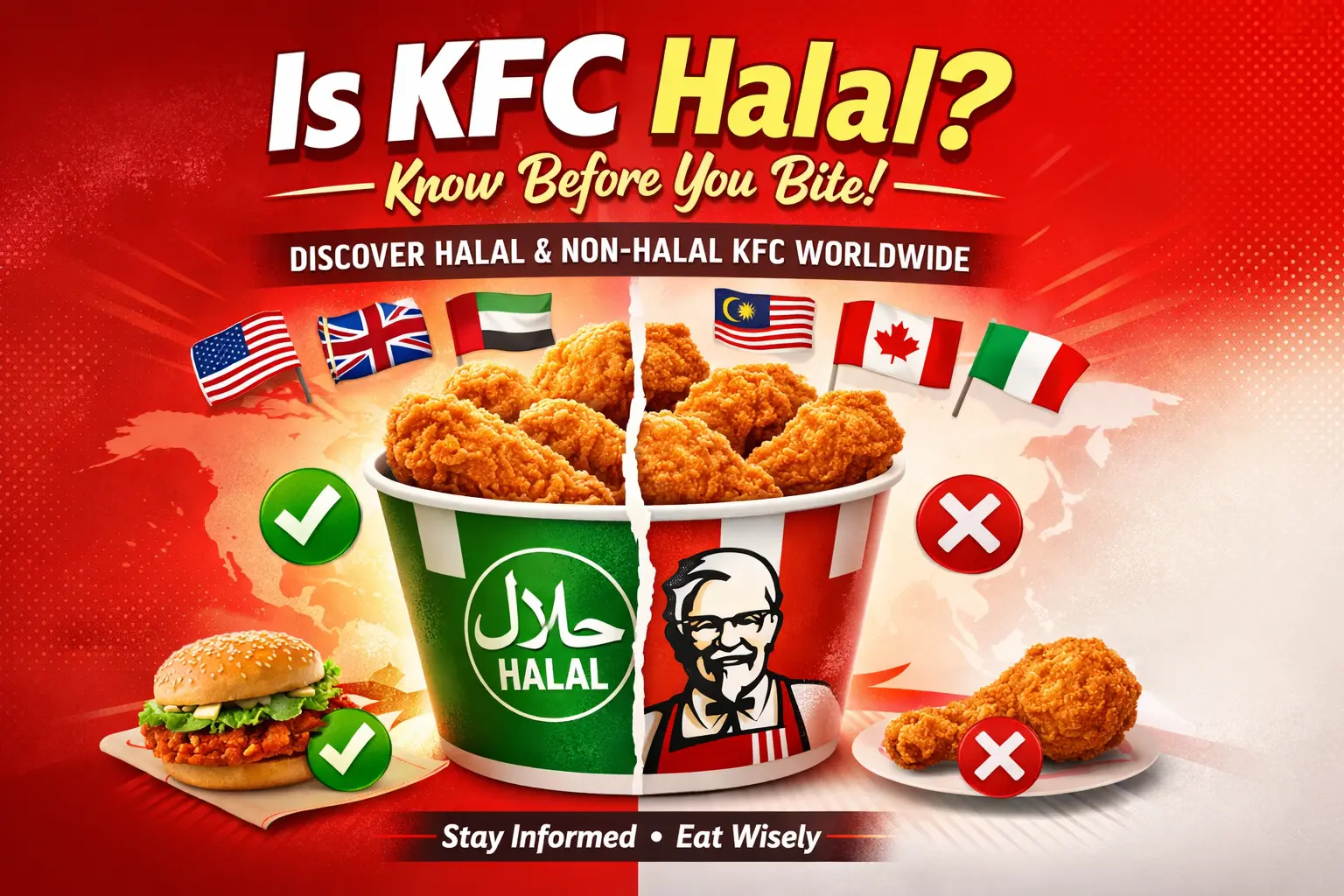
No, KFC menu in the United States is not halal-certified. While 200 locations in UK and Middle East are fully certified halal, U.S. branches do not use halal meat and are not inspected by recognized halal certification bodies.
This article focuses on facts, not assumptions. By understanding how KFC operates behind the counter, the question Is KFC halal becomes much clearer.
Official KFC Position on Halal (Country by Country)
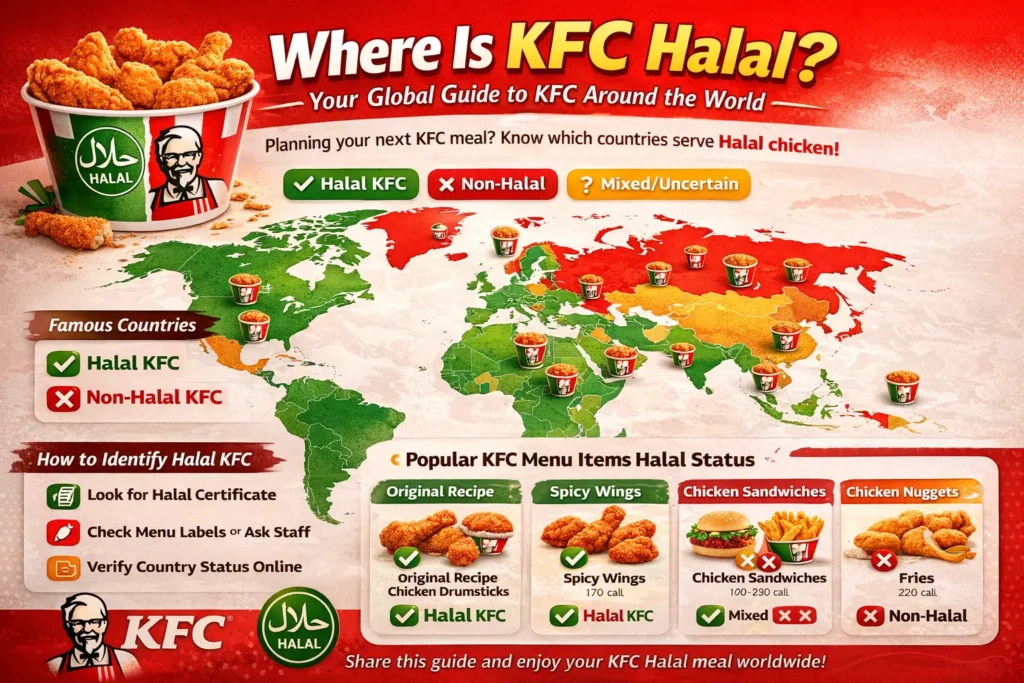
KFC’s halal stance varies by region, which adds to global confusion.
KFC itself has stated that halal sourcing is market-driven, not universal. This means the answer to Is KFC halal depends heavily on where you are eating — not just the brand name on the signboard.
|
Country |
Halal Status |
Note |
|---|---|---|
|
Canada |
Halal |
Nationwide rollout since 2024; Ontario is 100% Halal. |
|
United Kingdom |
Partially Halal |
~200 branches are Halal; look for the “Halal Authority” sticker. |
|
USA |
Non-Halal |
Generally not certified; only very rare individual franchises. |
|
Singapore |
100% Halal |
Fully certified by MUIS since 1994. |
|
Saudi Arabia |
100% Halal |
Strictly Halal and Sharia compliant. |
|
UAE |
100% Halal |
100% Halal certified nationwide. |
|
Qatar |
100% Halal |
100% Halal certified. |
|
Kuwait |
100% Halal |
100% Halal certified. |
|
Bahrain |
100% Halal |
100% Halal certified. |
|
Oman |
100% Halal |
100% Halal certified. |
|
Australia |
Partially Halal |
Many branches are Halal; others serve bacon. Check signage. |
|
France |
Partially Halal |
Growing number of Halal branches (24+), but most are not. |
|
New Zealand |
Partially Halal |
Meat is from Halal sources, but stores aren’t always certified. |
|
Japan |
Non-Halal |
Standard menu is non-Halal. |
|
South Korea |
Non-Halal |
Standard menu is non-Halal. |
|
Germany |
Non-Halal |
Generally non-Halal. |
|
Netherlands |
Partially Halal |
Only a few specific urban locations. |
|
Ireland |
Partially Halal |
Limited Halal locations; check for certification. |
|
Spain |
Non-Halal |
Standard menu is non-Halal. |
|
Italy |
Non-Halal |
Standard menu is non-Halal. |
|
Switzerland |
Non-Halal |
Standard menu is non-Halal. |
|
Norway |
Non-Halal |
Standard menu is non-Halal. |
|
Sweden |
Non-Halal |
Standard menu is non-Halal. |
|
Turkey |
100% Halal |
Fully certified and locally sourced. |
|
Malaysia |
100% Halal |
Certified by JAKIM; gold standard for Halal KFC. |
|
Indonesia |
100% Halal |
Fully certified by MUI/BPJPH. |
|
South Africa |
Halal (Most) |
Majority of branches are SANHA certified. |
|
Kazakhstan |
100% Halal |
Fully certified by local Islamic authorities. |
|
Jordan |
100% Halal |
Fully certified. |
|
Lebanon |
100% Halal |
Fully certified. |
|
Iraq |
100% Halal |
Fully certified. |
|
Thailand |
Partially Halal |
Halal-only branches common in the South and Bangkok. |
|
China |
Non-Halal |
Standard outlets are not Halal; some separate Muslim areas exist. |
|
Russia (Rostic’s) |
Partially Halal |
Now rebranded as Rostic’s; some locations in Muslim regions are Halal. |
|
Philippines |
Partially Halal |
Mostly non-Halal except in Muslim-majority regions. |
|
Brazil |
Non-Halal |
Non-Halal standard. |
|
Mexico |
Non-Halal |
Non-Halal standard. |
|
Argentina |
Non-Halal |
Non-Halal standard. |
|
Romania |
Non-Halal |
Non-Halal standard. |
|
Bulgaria |
Non-Halal |
Non-Halal standard. |
|
Pakistan |
100% Halal |
Fully certified; no pork on menu. |
|
India |
100% Halal |
Nationwide policy to use Halal-certified suppliers. |
|
Egypt |
100% Halal |
Fully certified. |
|
Bangladesh |
100% Halal |
Fully certified. |
|
Morocco |
100% Halal |
Fully certified. |
|
Tunisia |
100% Halal |
Fully certified. |
|
Sri Lanka |
100% Halal |
Certified by HAC. |
|
Uzbekistan |
100% Halal |
Fully certified. |
|
Nigeria |
Partially Halal |
Halal in the North; mixed/non-certified in the South. |
|
Kenya |
Partially Halal |
Some branches certified; check for the Halal logo. |
|
Ghana |
Partially Halal |
Some branches certified; check for signage. |
|
Vietnam |
Non-Halal |
Generally not certified. |
Understanding Halal
Halal status depends on how food is sourced, slaughtered, processed, and served — not on the brand name. For meat to be halal, every step of the process must comply with Islamic guidelines. If even one step fails, the food becomes non-halal.
This is where the question Is KFC halal becomes complicated.
KFC serves chicken, which is permissible in Islam. However, permissibility alone does not make it halal. The method of slaughter and processing matters just as much as the ingredient.
Read also: KFC Hot Wings Comeback Flavors and Ranking
How American Fast-Food Supply Chains Actually Work?
To properly answer Is KFC halal, it’s important to understand how fast food supply chains operate in the United States.
KFC is a global fast-food giant, operating in more than 150 countries and serving millions of meals every single day. When a brand is this big, people assume its food follows the same rules everywhere. That assumption is wrong.
KFC restaurants do not source chickens individually. They rely on centralized poultry suppliers that process massive volumes of meat daily. These suppliers serve multiple fast-food brands at once, not just KFC.
In the U.S. poultry industry:
This supply chain model is designed for efficiency, speed, and consistency. It is not designed for religious compliance. Because of this, even if a restaurant wanted to ensure halal food, it would have no control over how the chicken was slaughtered or handled upstream. That’s why the question Is KFC halal cannot be answered by looking at the restaurant alone; the answer starts much earlier in the supply chain.
Try also: KFC Chicken Pot Pie
The “People of the Book” Argument — Why It Fails in Fast Food
One of the most common arguments used to justify eating at KFC is this:
“Christians and Jews are People of the Book, so their food is halal.”
This argument often appears when people discuss Is KFC halal, but it is widely misunderstood.
Islamic scholars agree that meat from the People of the Book is permissible only if Islamic slaughter conditions are met. That allowance was given in a pre-industrial context, not for modern automated slaughterhouses.
In today’s fast-food industry:
Because of these factors, many scholars state that modern commercial slaughter does not qualify under the “People of the Book” allowance.
This is why the argument does not resolve the question Is KFC halal.
The issue is not the religion of the company — it is the method of slaughter.
Cross-Contamination
Even if halal meat were used, the question Is KFC halal would still remain unresolved due to cross-contamination. Fast-food kitchens are shared environments. In KFC outlets, the same equipment is often used for non-halal meat, halal-claimed items, cheese, sauces, and processed foods.
Common contamination risks include:
Islamic dietary law is clear:
Halal food becomes non-halal if it comes into contact with haram substances.
Explore: Latest KFC Deals 2026 | KFC Bucket Specials Today & Meal Deals
Is KFC Halal in the United States? (Clear Answer)
This is where most readers want a direct answer to Is KFC halal.
In the United States, the answer is generally no.
KFC has publicly stated that halal chicken is not standard across U.S. locations. While there may be isolated cases of halal sourcing, these are exceptions, not the rule. Most American KFC outlets rely on the same industrial poultry supply chain used by other fast-food brands.
There is also no nationwide halal certification program for KFC in the U.S. Without certification, claims of halal compliance cannot be verified.
From a halal perspective, scholars emphasize a key principle:
If halal status is uncertain, it should be avoided.
This is why most halal councils advise Muslims in the U.S. not to assume KFC is halal unless clear, written certification is provided. So when asking Is KFC halal in America, the safest conclusion remains no.
Can Muslims Eat Vegetarian or Fish Items at KFC?
Some people try to bypass the chicken question by ordering vegetarian or fish items. This often comes up when discussing Is KFC halal.
In theory, vegetables and fish are halal by nature. However, in fast-food environments, preparation matters as much as ingredients.
At most KFC locations:
Because of this, many scholars advise caution. Food that is halal in isolation may become non-halal due to shared fryers or surfaces.
This means ordering non-meat items does not automatically solve the Is KFC halal concern.
Check also: Save Big with KFC Family Deal
How to Verify If a Specific KFC Outlet Is Halal?
If you still want to know Is KFC halal at a specific location, verification is essential.
Authentic halal outlets are usually transparent. They display certification clearly and openly state their halal practices.
What to look for:
If certification is missing, the halal status remains uncertain.
FAQs
Final Verdict: Is KFC Halal or Haram?
So, Is KFC halal? The most accurate answer is:
- In the United States: Generally not halal
- Globally: Depends entirely on country, certification, and supply chain
Without clear halal certification, KFC should not be assumed halal. Brand reputation does not replace religious compliance.
For Muslim consumers, informed choices matter. Understanding how food is sourced and prepared turns confusion into clarity — and allows faith-based decisions to be made with confidence.